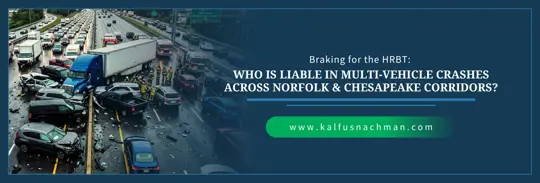
Driving through Hampton Roads can be challenging even under normal conditions. Add heavy commuter traffic, active construction, lane reductions, and tunnel congestion, and a routine trip can become a serious crash risk. The I-64 Hampton Roads Bridge-Tunnel (HRBT), High-Rise Bridge, I-264 interchange, and Hampton Roads Express Lanes regularly carry large volumes of passenger vehicles and commercial traffic.
Sudden braking is a huge problem in these corridors. You might hit unexpected traffic near a tunnel entrance or a lane that just disappears, and before you know it, there's a chain reaction pileup.
And figuring out who is liable in multi-vehicle crashes across Norfolk & Chesapeake Corridors? It's not always as cut-and-dried as pointing to the driver who rear-ended someone. Plenty of factors can come into play—other drivers, the road conditions, even construction-related issues.
Why Sudden Braking Creates HRBT Crash Risks
Traffic around the HRBT can change rapidly. A driver traveling at highway speed may suddenly encounter what appears to be "phantom traffic"—a slowdown caused by congestion farther ahead rather than a visible obstacle.
Lane drops and merging traffic only make things worse. If one driver brakes abruptly, following motorists may have only a few seconds to react. The result can be a chain reaction involving several vehicles.
Similar conditions can occur near the High-Rise Bridge and I-264 interchanges, where traffic volumes and merging movements create frequent speed changes.
For anyone searching for a Norfolk I-64 accident lawyer, understanding how and why the initial slowdown occurred can be an important part of determining liability.
Who Is Liable in a Multi-Vehicle Crash in VA?
Liability in a multi-vehicle accident depends on the specific facts. The driver who rear-ends another vehicle may be considered responsible, but that does not automatically make them liable for every vehicle involved.
For example, suppose Vehicle A stops suddenly because of congestion. Vehicle B strikes A, and Vehicle C then strikes B. Investigators may need to determine whether each driver maintained a reasonable following distance, whether a driver was speeding or distracted, and whether another factor caused the initial slowdown.
Construction adds another layer of headache—narrow shoulders, shifting lanes, concrete barriers, and traffic patterns that seem to change daily. All of that can mess with a driver's ability to react safely.
To figure out what really happened, you'll want to look at things like traffic camera footage, vehicle damage, photos from the scene, witness accounts, police reports, and any data pulled from the vehicles themselves.
HRBT Construction and Traffic Issues in Hampton Roads
In the Hampton Roads region, large infrastructure projects can temporarily disrupt familiar driving patterns. Construction zones often have narrowed lanes, lane shifts, reduced shoulders, and constantly changing signs and signals.
Bottom line: slow down, expect sudden jams, and leave extra room between you and the car ahead. Same goes for the High-Rise Bridge, the I-264 interchange, and any other busy corridor around here.
For injured motorists, however, determining whether construction conditions contributed to a collision can require a more detailed investigation.
Virginia's Contributory Negligence Rule Matters
Virginia has a pretty tough rule when it comes to fault—it's called pure contributory negligence. Basically, if you're found to have any role in causing your own injury, even just a little bit, you could be completely barred from recovering any compensation.
This makes fault particularly important in Hampton Roads multi-vehicle crashes. An insurance company may argue that a driver was "tailgating," speeding, distracted, or otherwise failed to maintain a safe distance. A rear-end impact does not automatically resolve every question of fault—the circumstances leading to the collision matter, particularly when several vehicles are involved.
Anyone dealing with an HRBT rear-end crash attorney may benefit from having the accident investigated before accepting an insurer's version of events.
Protect Your Rights After a Hampton Roads Crash
A multi-car crash can leave you buried in medical bills, car repairs, lost income, and a whole lot of confusion about who's actually at fault. And since Virginia's contributory negligence rule can make the question of blame a make-or-break issue, getting legal advice early on can really make a difference.
If you've been injured in an HRBT, High-Rise Bridge, or other Norfolk or Chesapeake corridor crash, Kalfus & Nachman is ready to help. Contact our team today for a free consultation to discuss your legal options: 855-880-8163