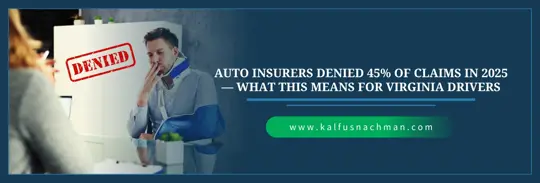
The headline “Auto Insurers Denied 45% of Claims” can be alarming, but consumers should understand what a statistic like this means before drawing conclusions. Claim-denial rates can vary widely by insurer, coverage type, jurisdiction, and how claims are counted. Still, the broader lesson is important: an insurance claim is not necessarily guaranteed to result in payment.
For Virginia accident victims, knowing your rights and documenting your losses can be critical.
Why Liability and Medical Claims Face the Most Rejection
According to The Wall Street Journal's review of insurer filings with the National Association of Insurance Commissioners from 2016 through 2025, , the 45% denial rate applies specifically to liability and medical claims—the categories involving injuries, treatment costs, and disputes over fault. On the other hand, physical damage claims (for vehicle repairs) fare much better, with roughly three-quarters resulting in payment.
Why the disparity? Injury claims are usually more expensive and complicated. They often involve detailed medical records, causation disputes, potential long-term care needs, and other stuff. On top of that, insurers are tightening their rules, which can lead to more disputes and issues with payment.
Not Every Unpaid Claim Means a Wrongful Denial
Not every unpaid closure means a wrongful denial. Regulatory data shows claims can close with zero dollars paid for several reasons:
• Another party's insurance covered the loss
• Damages fell below the policy deductible
• The policyholder voluntarily withdrew the claim
• The incident fell outside explicit policy bounds or was fraudulent
Which Insurers Are Most Likely to Deny?
Farmers, Liberty Mutual, and State Farm recorded the largest increases in nonpayment rates for liability and medical claims among the 10 biggest auto insurers over the past decade. State Farm's crackdown has been particularly notable: the company added language requiring customers to report new regular drivers, claiming undisclosed drivers cost it nearly $1.5 billion annually.
Why Virginia Drivers Are Especially Vulnerable
Virginia follows a strict legal standard known as contributory negligence. If an insurance company can establish you were even 1% at fault for an accident, they can deny your entire claim under Virginia law. This harsh rule makes the 45% nonpayment trend especially dangerous for Virginia drivers.
Common reasons for Virginia claim denials include disputed liability, coverage exclusions, lack of medical causation, and failure to cooperate with the insurer's investigation.
Virginia law also recognizes remedies in certain circumstances when an insurer arbitrarily refuses to pay a motor-vehicle insurance claim in bad faith. Depending on the claim type and circumstances, courts may award additional damages and attorney fees.
How Insurance Adjusters Minimize Payouts
Claims adjusters are trained to protect their company's bottom line. Here are a few common tactics:
• Disputing liability by shifting blame.
• Arguing your injuries are pre-existing.
• Using delays to wear you down.
• Offering quick lowball settlements.
• Using your own words against you.
Legal Guidance Can Make a Difference
Insurance companies handle claims every day. An injured person may be dealing with a claim for the first time while simultaneously managing pain, medical appointments, missed work, and uncertainty about the future.
That imbalance is one reason many accident victims choose to consult Virginia Personal Injury attorneys before accepting a settlement or giving extensive statements to an insurer.
Experienced attorneys can investigate the circumstances of a collision, review the available insurance coverage, assess damages, communicate with insurance representatives, and determine whether the evidence supports the insurer's position. A careful investigation can therefore be essential when liability is disputed.
If your auto insurance or injury claim has been denied, delayed, or undervalued after a Virginia accident, Kalfus & Nachman is ready to help. Contact our team today for a free consultation to discuss your situation and learn about your legal options: 855-880-8163